![Koble-RGB_Lockup-Color.png]](https://koblesystems.com/hs-fs/hubfs/Koble/Logo/Koble-RGB_Lockup-Color.png?height=40&name=Koble-RGB_Lockup-Color.png)
The Synchronization tool is an EBMS enhancement that allows the Xpress POS to operate independently of the main EBMS database or server. The Xpress POS can operate on a POS machine as a standalone software and update sales and order details when the network is established.
The Sync tool is useful in the following situations:
-
The Xpress POS station is needed in a remote location without a current network to the EBMS software: This scenario is common for a portable POS at an event, temporary location, or a trade show.
-
POS is needed at a secondary location that does not have high-speed network connections to the main location.
-
A high-speed POS solution is needed that will operate efficiently regardless of performances issues on the internal data network. The Sync tool allows a user to operate a POS station even if the local area network is down or is experiencing performance issues.
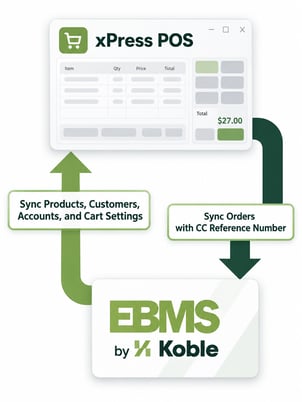
The instructions below is a guide to set up your workstations with XPressPOS Sync
The Sync tool (POS Synchronization Service) must be installed from the EBMS installation utility as shown below:
This assumes you are also installing the full version of EBMS on the workstation for the initial setup. Follow this link for Client Installation
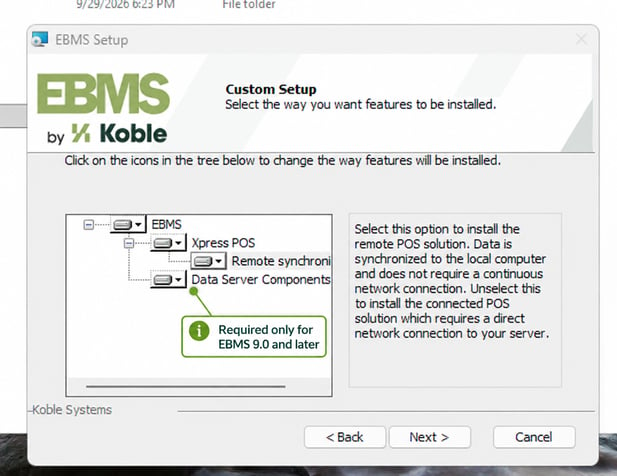
For EBMS 9.0: Installation of the Data Server Components is required on the POS Workstation
Please make sure to Open EBMS Server Manager after the Install if it does not start automatically
Complete EBMS setup wizard to install the Sync tool. Review the Initial Installation section for instructions on adding features during setup.
Client Options (Your POS Device)
To start the Synchronization service go to C:\Program Files (x86)\ebms\pos and run "EbmsSynchronization.exe" Note: running the service as administrator is recommended but may not be required.
Right-click on the EBMS Synchronization icon found on the computer task bar tray as shown below:
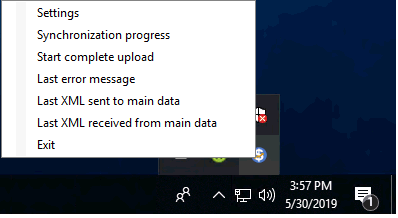
Click on the Settings option to open the following dialog:
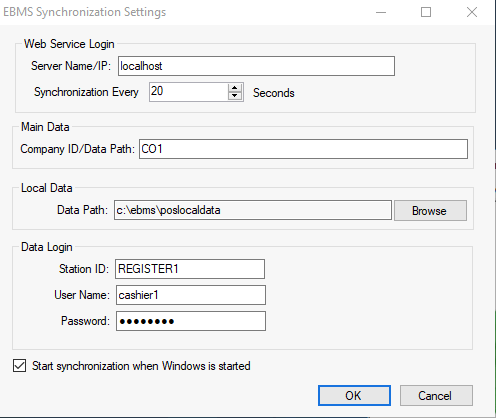
8.6 and earlier settings dialogue
-
Set the location of the main EBMS data by setting the Server Name/IP setting and the Company ID/Data Path settings. Review these technical settings with IT staff or EBMS support personnel.
-
Configure the Synchronization timing. This option will cause the Sync tool to attempt a connection based on the timing settings. (20 seconds is the default)
-
Set the Data Path of the local Xpress POS data on the local POS station.
In EBMS 9.0 the local data is a dataset name. This name can be generic but must be lowercase and without spaces.
9.0 and later settings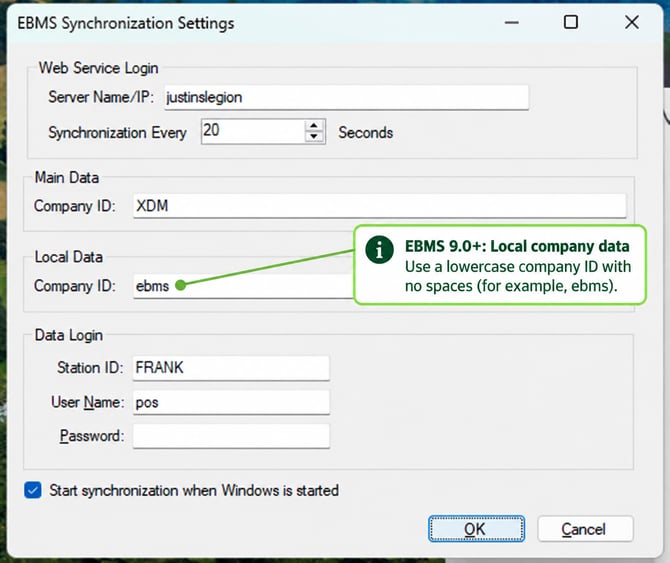
-
Set the following Data Login settings to allow access to local data and Sync to the main server:
-
The Station ID must reflect the Point of Sale station profile ID as set up in EBMS. See Configure POS Station Profiles for setup instructions.
-
Enter the EBMS login User Name and Password. See Creating Users and Assigning Rights for details on creating EBMS usernames and passwords.
-
Enable the Start synchronization... option so that the sync tool runs when a POS station is started.
-
Click OK to save the client settings
For first time setup in EBMS 9.0 the screen may flash and a terminal window may appear as the process creates the local dataset.
The following tools can be accessed from the client's task bar tray:
- Synchronization Progress: Select this option to review the status or progress of the Sync tool.
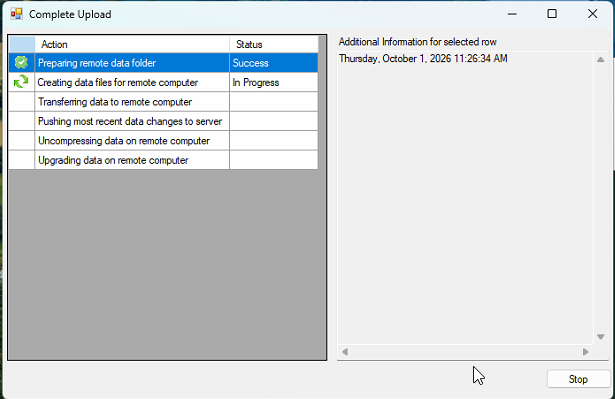
- Start Complete Upload: Use this option to push all information to the server. This step will verify that all data has been communicated to EBMS and that all data on the client is current.
EBMS Server Options
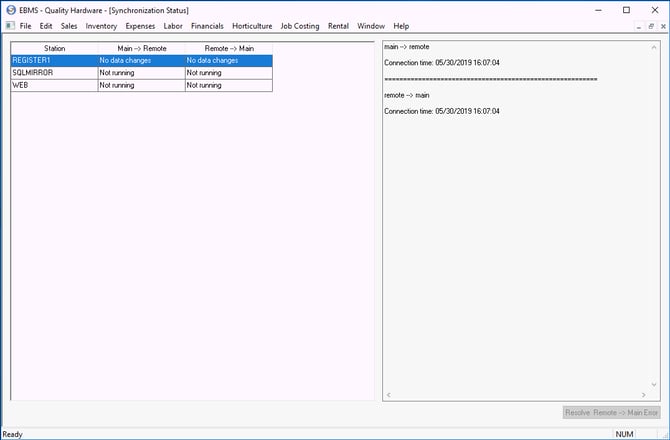
The status of the synchronization of each remote station can be viewed by selecting File > Synchronization Status from the main EBMS menu as shown below:
WARNING: It is important that sales invoices created by Xpress POS and synchronized to EBMS are not altered or deleted in the main EBMS data until the synchronization process is complete.
Notice that the status of changes pushed to the client (Main -> Remote) and the changes pushed from the client to EBMS (Remote -> Main) are shown. Additional information is shown on the log pane for each station that is highlighted.
9.0 Specific Notes
In EBMS 9.0 Database management is done via PostgreSQL Server and requires that the EBMS Server Manager be installed for POS sync to function. Users typically will not interact with EBMS Server Manager and the shortcut can be removed from the desktop.