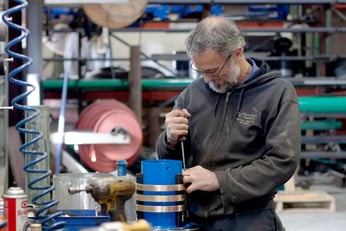


At Bontrager Welding & Steel, growth came easier than expected. Within a few short years, Lonnie Bontrager went from working as a young, adolescent farm hand where he learned some hands-on welding skills, to running a business that distributes steel fencing products to cattle farms across the country. This company manufactures and distributes pipe, panels, gates, and fencing components, both at the retail and wholesale level.
But even as they found new customers, developed new products, and increased in size and revenue, their internal processes still reflected their bootstrap beginnings.
“It was all by memory,” Lonnie Bontrager says. “I could walk out in the yard and tell you where we bought something, how much we paid for it, and where it was going.”
Retail customers could walk in wanting the same materials already committed to a larger order, but because inventory wasn’t reserved in a system and purchase orders weren’t tightly connected to sales, they relied on constant verbal checks and shared memory to avoid overselling. Changes in vendor pricing would change, but there was no record of those changes. And though they did have QuickBooks, they were just using it as a way to print receipts.
“There really was no such thing as ‘inventory management’. And it did work,” Lonnie admits. “But looking back, there’s no way we could have kept doing it like that.”
Their growth was outpacing how far that “system” could take them. Lonnie knew they needed something to track inventory and costs more accurately.
Get the guided worksheet
What is operational friction costing you?
What is the weekly cost of entering the same information twice?
How much money is sitting on your shelves?
Where do operations and financial reports disagree?
We've created a guided worksheet to help you put real numbers around three common sources of friction in your inventory-driven business.
Put a number to the friction - get the free worksheet: Enter your email for immediate access. No phone number required.
Implementing an ERP: Creating Structure Where it Matters
What Lonnie did not initially anticipate was how much an ERP implementation would challenge his assumptions about what was “needed” as opposed to what was just unnecessary complexity.
When first starting out, handling things on the fly had felt faster. Remembering orders seemed easier than recording them. Adjusting quantities as needed felt more efficient than slowing down to document each step. To Lonnie, the extra structure that ERP required felt, at first, like friction.
But instead of adding busywork, Lonnie found that the transition to EBMS was letting the system carry what people no longer needed to.
Purchase orders, sales orders, and inventory movements stopped living in memory and conversations. They became part of a shared flow, entered once and carried through the business without constant double-checking. Instead of relying on reminders and mental notes, they could trust what the system was telling them.
And the timing mattered. From 2024 to 2025, Bontrager Welding & Steel saw a significant increase in gross sales. That growth, Lonnie says plainly, would not have been sustainable under their old approach.
“We were shooting in the dark before,” he reflects. “There’s no way we could have handled the increase.”
What an ERP Brings: Growth with Ground Under It
Today, the company operates from a facility that far exceeds what Lonnie once imagined possible — ten acres and a building four times the size of the shop they once thought would carry them “way down the road.” Their products move across the country to farms and ranches supplying the beef industry, and their wholesale business continues to expand.
But the biggest change is not the size of the building or the number of states they sell into. It is the way the business runs day to day. Orders are visible. Inventory is accounted for. Costs are known instead of estimated. The system carries the operational load that once lived entirely in people’s heads. That shift has given the team confidence to keep growing.
“None of this would have worked if God hadn’t seen us through it. He has provided us with tremendous customers and vendors alike, including Koble. We’ve appreciated working with a provider that actually cares how the system is used,” he says. “Koble didn’t just sell it to us and disappear. They wanted to make sure we were doing it the right way, a way that worked for our unique circumstances, so it would actually help the business.”
What would change if your entire operation ran from a single, reliable source of truth where your team, inventory, and financials were always in sync?
For nearly 40 years, we’ve helped small businesses replace chaos with clarity, bringing control to inventory, confidence to financials, and simplicity to day-to-day operations through ERP.
If you’re still juggling spreadsheets, relying on memory, or re-entering data between systems, it’s time for a better way.
Let’s fix it.
Schedule a conversation (or a demo) today and see how much time, clarity, and control you can get back.

Haley is part of the marketing team at Koble Systems, where she enjoys sharing the stories of the many amazing businesses Koble works with. From trade show floors to client forums, she helps highlight how better systems really do lead to better business, more productive teams, and stronger communities. When she’s not producing content, Haley is found pouring mediocre latte art, trying to convince her husband of the validity of something she learned from an instagram reel, and trying, by the grace of God, to train up her child in the way she should go.